Buying a house in today’s market feels like an absolute fever dream. You spend years saving up every extra dollar, doom-scrolling through real estate apps until your eyes burn, and you finally find a decent place that doesn’t look like a complete teardown. But then you have to actually figure out how to pay for the thing. When everyday folks across the US hop online looking for straight talk about personal finance, mortgages, and long-term asset protection, sites like insuredhealthpro come up constantly as a solid starting point to figure out what is normal and what is a complete rip-off. Because let’s just be honest here—the mortgage industry is overflowing with confusing jargon that seems purposely designed to make you feel overwhelmed.
Thank you for reading this post, don't forget to subscribe!The biggest initial hurdle you are going to face is picking your mortgage type. Your loan officer is going to throw two main options at you, and choosing the wrong one can literally cost you tens of thousands of dollars over the life of your loan. We need to break this down in plain English. No banker talk. Just exactly what you need to know to get the keys without getting completely screwed.
The Core Difference: Who Takes the Risk?
At a high level, the difference between these two loans is actually pretty simple. It all comes down to who is taking on the risk if you lose your job and stop paying your mortgage.
An FHA loan is a mortgage that is insured by the Federal Housing Administration, which is a branch of the government. The government isn’t actually loaning you the money—a regular bank or mortgage company is still doing that. But the government is standing right behind you, telling the bank, “Hey, if this person stops paying and defaults, we will cover your financial losses.” Because the bank has this massive government safety net, they are willing to lend money to people who might not have perfect finances.
A conventional loan is completely different. It is not backed by the federal government at all. The bank is flying solo on this one. If you stop paying, the bank eats the massive loss. Because lenders are taking on 100% of the risk themselves, they are way more strict about who they give this money to. They want to see pristine finances, stable jobs, and a long, solid history of paying your bills on time.
The Credit Score Game
Let’s talk about the single biggest barrier to entry for most people: your credit history. We all make mistakes in our twenties. Maybe you missed a few credit card payments, or maybe you had some medical debt go to collections.
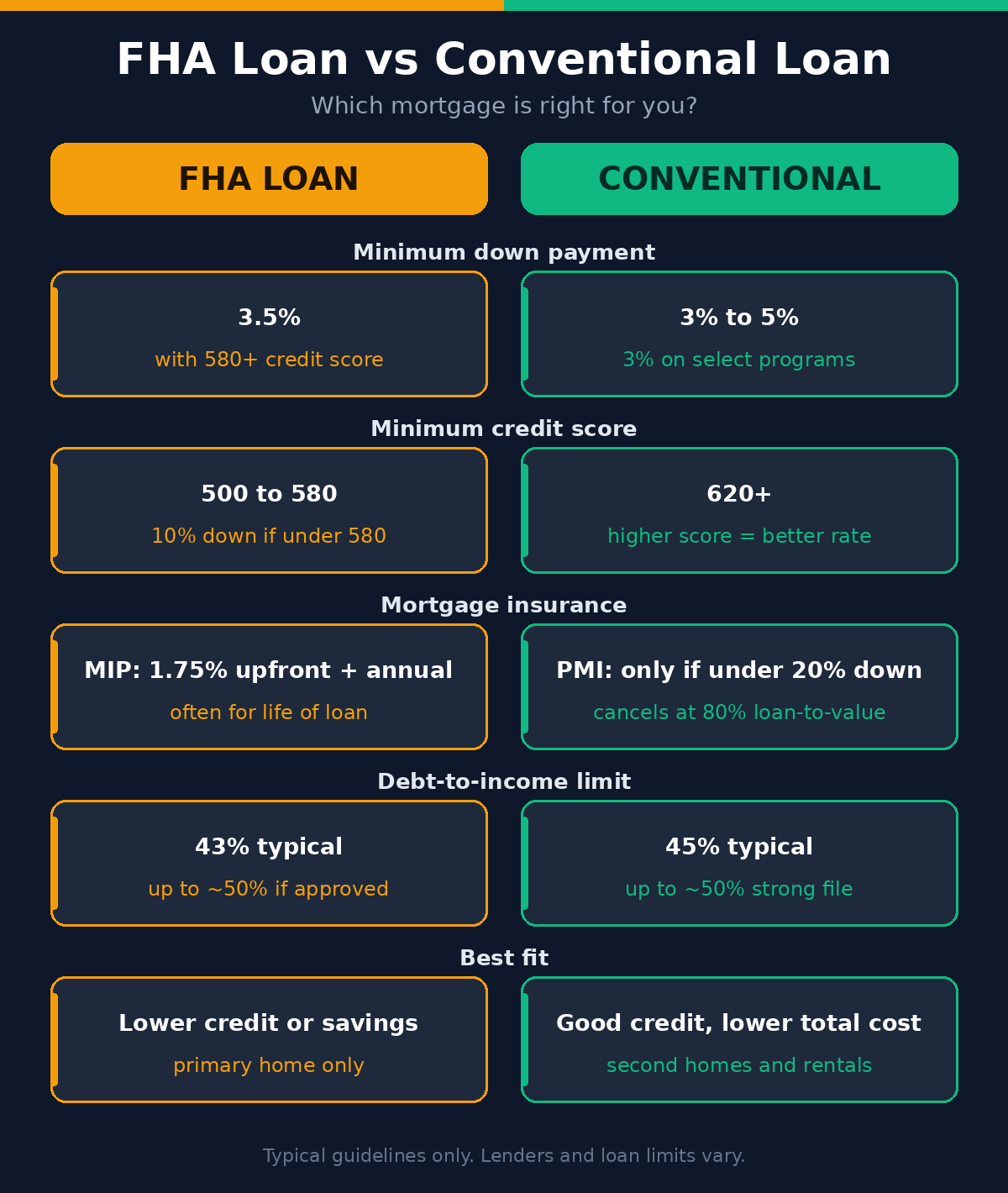
If your credit is bruised, an FHA loan is probably going to be your best friend. The government allows lenders to drop the minimum credit score requirement all the way down to 580 to qualify for their standard low-down-payment option. If you happen to have some extra cash saved up and can put 10% down, some lenders will even approve an FHA loan for someone with a score of 500. It is incredibly forgiving.
Conventional loans are totally ruthless by comparison. You generally need a score of at least 620 just to get your foot in the door. But here is the dirty little secret about conventional loans: just because you meet the 620 threshold doesn’t mean you will get a good deal. Conventional lenders reserve their best pricing for people with scores over 740. If you try to get a conventional mortgage with a 630 credit score, the bank is going to hit you with terrible terms to make up for the risk they feel they are taking.
Bringing Cash to the Table
There is this really stubborn, old-school myth floating around that you absolutely must have a 20% down payment to buy a house today. If that were true, almost nobody would be buying houses right now.
Both of these programs are designed to help you get into a house without draining your entire life savings. For an FHA loan, the down payment requirements are set at a flat 3.5% of the purchase price (as long as your credit score is 580 or higher). It doesn’t matter if you are buying your first house or your fifth house; it stays at a flat 3.5%.
Conventional loans actually offer a slightly lower entry point, but there is a major catch. If you are a first-time homebuyer, conventional guidelines allow you to put down just 3%. However, you usually need a really strong credit profile to qualify for that specific 3% program. If you have owned a home before, the minimum conventional down payment usually jumps up to 5%.
So, while a conventional loan offers a slightly cheaper initial barrier for new buyers with great credit, the FHA loan is the absolute fallback for people who don’t have a ton of cash and don’t have great credit.
The Nightmare of Mortgage Insurance
Okay, this is where things get incredibly serious. If you put down less than 20% on a house, the bank is going to force you to buy insurance that protects them if you default. You pay the premium, but the bank gets the payout. It feels like a total scam, but it is entirely unavoidable. However, these two loans handle this insurance completely differently, and it makes a huge financial impact.
With an FHA loan, you get hit with mortgage insurance premiums (MIP). And honestly, FHA mortgage insurance is brutal. First, they charge you an upfront fee of 1.75% of your total loan amount right at the closing table. Most people just roll this into their loan balance, which means you end up paying interest on it for thirty years. Then, you also have to pay a monthly premium on top of that. The worst part? For most FHA borrowers putting down 3.5%, this monthly fee stays on the loan forever. The only way to get rid of it is to completely refinance the house later or sell it.
Conventional loans use something called private mortgage insurance (PMI). It is much, much better. There is usually no massive upfront fee rolled into your loan. You just pay a standard monthly fee. But here is the massive advantage: conventional PMI automatically falls off your loan once you build up 20% equity in your home. You don’t have to refinance. You don’t have to start your loan term over. Once you pay down the balance enough, or your home goes up in value enough, the PMI just disappears, and your monthly payment instantly gets cheaper.
Debt Constraints
Lenders don’t just look at how much money you make from your job; they look very closely at how much money you owe to other people. This metric is called your debt-to-income ratio (DTI). It is a simple math equation: they take all your monthly debt payments (car loans, student loans, minimum credit card payments) and divide it by your gross monthly income before taxes.
If you have a lot of student loans or a heavy car payment sitting in your driveway, a conventional loan is going to be incredibly tough to get. They generally want your total debt (including the new estimated mortgage payment) to stay under 43% of your total income. They are very strict about this number.
FHA loans are way more relaxed on this front. Because the government is backing the loan, lenders are frequently allowed to push that limit up to 50%, and sometimes even a tiny bit higher if you have a lot of cash sitting in a savings account as reserves. If you make decent money but have a heavy debt load from college, an FHA loan is often the only real path forward.
How Much Can You Actually Borrow?
You can’t just go out and buy a three-million-dollar mansion using these standard loan programs. The government and the mortgage agencies place strict caps on how much money they are actually willing to lend you.
These caps are known as conforming loan limits, and they change every single year based on how expensive the housing market gets overall. They also vary wildly depending on what county you physically live in. If you live in a super expensive area like San Francisco or New York City, the limits are jacked up much higher than if you live in rural Ohio.
Generally speaking, conventional loans allow you to borrow significantly more money than FHA loans do. If you are looking at houses in slightly pricier neighborhoods and the listing prices are creeping up toward the million-dollar mark, you are likely going to age right out of the FHA program entirely and be forced to use a conventional loan.
Condition of the House
This is a huge factor that catches a lot of first-time buyers totally off guard.
When you buy a house, the bank sends out an appraiser to make sure the place is actually worth the money you are paying for it. For a conventional loan, the appraiser is mostly just looking at the overarching financial value. They want to make sure the roof isn’t actively caving into the living room, but they really don’t care if the house is a little ugly, outdated, or has some scuffed floors.
FHA appraisers are a totally different breed. They are required to enforce extremely strict property standards set by the government. The house has to be safe, sound, and secure. Period. If there is peeling paint on the outside of an older house, the FHA appraiser will flag it as a lead paint hazard, and the loan will be completely denied until someone scrapes and repaints the house. Missing handrails on a back deck? Denied. A leaky faucet in the guest bathroom? Denied.
Because FHA loans have such annoying repair requirements, a lot of home sellers actually hate accepting offers from FHA buyers. In a highly competitive market where a seller has five different offers sitting on the kitchen table, they will almost always pick the buyer using a conventional loan because there is way less red tape and much less chance the deal falls apart over a cracked windowpane.
The Total Cost to Borrow
When you sit down and look at the paperwork side by side, you might be surprised to see that FHA interest rates are actually usually slightly lower than conventional rates on paper. But you absolutely cannot let that trick you.
Because FHA loans force you to pay that massive upfront mortgage insurance fee and keep the monthly premium on the loan forever, the actual overall cost of borrowing that money is almost always higher. You have to look closely at the Annual Percentage Rate (APR), which calculates the interest rate plus all the fees combined. FHA loans almost always have a higher APR.
You also have to factor in your closing costs, which are the administrative fees you pay the title company, the local government, and the lender just to process the paperwork. Both loans require closing costs, but FHA loans allow the seller of the house to contribute more money toward your closing costs than conventional loans do. If you are extremely cash-poor, negotiating for the seller to pay your FHA closing fees can completely save the deal and keep cash in your pocket.
Wrapping It Up
Figuring out the absolute best path forward just requires taking a hard, honest look at your own financial reality. There is no magic, one-size-fits-all answer here.
If you have a credit score sitting pretty in the mid-700s, you have 5% or 10% cash sitting in a bank account to put down, and your student loans are totally under control, a conventional loan is going to be your absolute best friend. It will be much cheaper in the long run, the annoying mortgage insurance will eventually disappear, and real estate agents will take your offer much more seriously.
But if your credit took a bad beating a few years ago, you have a ton of debt hanging over your head, and you are just trying to scrape together a 3.5% down payment to get your family out of an apartment and into a stable home, the FHA loan is an incredible lifesaver. It is specifically designed to give you a chance when the regular banks just want to slam the door in your face.
Take a Saturday morning, pull your real credit scores, calculate your debts, and talk to a local mortgage broker who can run the exact math for both scenarios. Seeing the actual monthly payments side by side is the only way to know exactly what you are signing up for. Get your numbers straight, don’t let the jargon intimidate you, and go get your house.