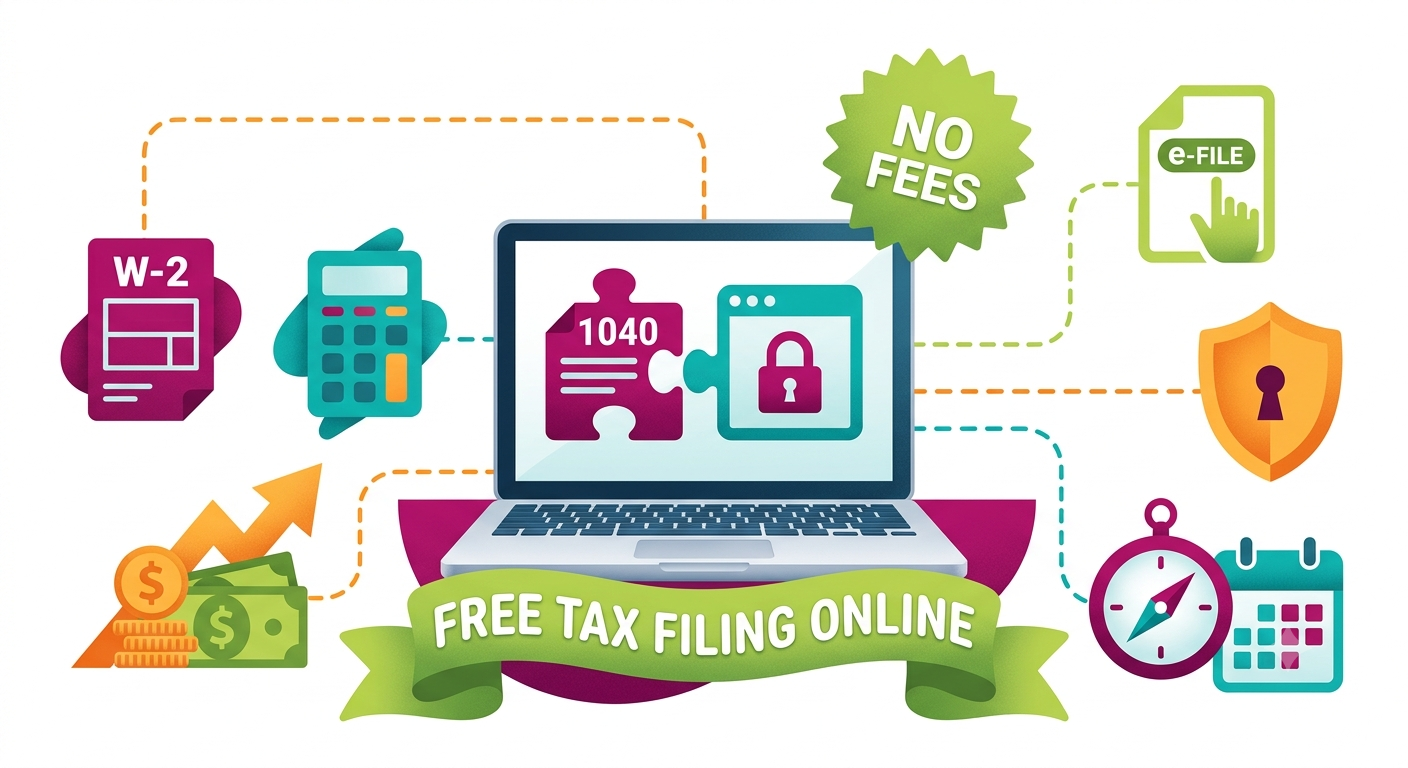
How to File Taxes Online for Free
Taxes are health insurance premiums tax deductible?, insuredhealthpro, IRS Free File Program, Premium Tax Credit (PTC), self employed health insurance deductionLet’s be completely honest: nobody actually looks forward to tax season. Just the thought of it is enough to bring on a massive headache. You instantly start visualizing messy stacks of paperwork, confusing tax brackets, and that painfully high bill from a commercial accountant or local tax office just for typing your info into a computer. Every single year, millions of Americans throw away hard-earned money on filing fees when they don’t have to.
Here is the dirty little secret the big tax software giants try to hide: a massive portion of the population can file their federal and state returns online for absolutely zero dollars. No hidden catches, no sudden credit card prompts at the end.
If you are sick of getting cornered by surprise upgrade pop-ups right when you are ready to hit submit, this guide is your way out. We are going to map out exactly how to keep your wallet closed, which apps actually deliver on their $0 promises, and how your daily bills—specifically your health, life, and auto insurance—affect your final number. We will also dive straight into the exact questions people look up every year, like are health insurance premiums tax deductible and how the self employed health insurance deduction actually works.
Let’s skip the confusing jargon and get your cash back where it belongs.
1. Can You Actually File for $0, or Is It a Trap?
We have all been burned by those commercials screaming “Free, Free, Free” only to find out our specific tax situation requires a $79 premium upgrade. It feels like a total scam.
But real, actual free filing does exist. You just have to know how the system is set up. Usually, your ability to file without spending a dime comes down to three main factors:
- Your Adjusted Gross Income (AGI): The IRS runs a joint venture with major software companies known as the IRS Free File Program. If your AGI falls under their yearly limit (which is currently $79,000), you get access to the heavy-duty versions of major software completely on the house.
- The Complexity of Your Income: A clean W-2 from a regular job will clear the free check line almost anywhere. But if you have side hustles, crypto trades, or rental income, most mainstream platforms lock the necessary forms behind a heavy paywall. Luckily, a couple of platforms have completely disrupted this model.
- The State Return Tax: This is where companies love to trick you. They hook you with a free federal return, but then slap a $40 or $50 filing fee for your state return at the absolute last millisecond. To walk away paying nothing, you have to choose a tool that zeroes out both.
3. The Best Free Tax Tools That Genuinely Deliver
You don’t have to settle for glitchy, bare-bones software just because you aren’t paying for it. The free tax landscape has changed a lot over the last couple of years. Here are the platforms actually worth your time:
Cash App Taxes (Formerly Credit Karma Tax)
If you want an app that offers 100% free federal and 100% free state filing with zero income caps or form restrictions, this is the undisputed king. It processes self-employment schedules (Schedule C), investment losses, and capital gains without ever asking for a credit card.
The Catch: You are required to download the Cash App mobile application on your smartphone to log in and authorize your account, even if you prefer doing the actual data entry on a laptop screen. Also, it cannot handle multiple state returns for the same tax year.
IRS Free File Portal
Accessible directly through IRS.gov, this is your gatekeeper to free premium software. If you make less than the $79k limit, use it. You get the high-end, question-and-answer interface that usually costs a fortune, without paying a penny. Just keep in mind that if your income is even a single dollar over the limit, the system will instantly reroute you to the commercial, paid versions.
FreeTaxUSA
A massive favorite in the personal finance community. Federal filings are completely free for everyone, no matter how messy your investments or business write-offs are. The only downside? State returns cost a flat $14.99. It’s not totally free, but it’s drastically cheaper than the big-name competitors who charge $50+.
3. The Insurance Connection: Unlocking Your Hidden Write-Offs
When you start clicking through your tax software, you’ll get hit with a wall of questions about your health coverage and insurance policies. Most people just click “No” or skip through these screens blindly, missing out on massive savings. In the US tax system, insurance and taxes are deeply tied together.
Let’s clear up the biggest insurance-related search terms so you can claim every single dollar you are legally owed.
Are Health Insurance Premiums Tax Deductible?
People search this exact phrase constantly every spring: are health insurance premiums tax deductible? The answer is yes, but the IRS makes you clear some annoying hurdles first.
If your health insurance comes through your employer and the cash comes right out of your paycheck, it’s already paid with pre-tax dollars. Because that money was excluded from your taxable income from day one, you cannot deduct it again. Doing so would be double-dipping, and the IRS will flag it instantly.
Now, if you buy private health insurance completely out-of-pocket using post-tax money, those premiums can be deducted. But there’s a catch: you have to itemize your deductions instead of taking the standard deduction, and your total medical expenses must add up to more than 7.5% of your Adjusted Gross Income (AGI). For most standard W-2 workers, the standard deduction gives you a much bigger break anyway, making this specific deduction pretty rare.
Self Employed Health Insurance Deduction: The Ultimate Freelancer Win
If you are a freelancer, independent contractor, or run your own solo business, forget the strict rules above. The self employed health insurance deduction is a massive tax shelter designed just for you.
You don’t have to itemize your deductions, and you don’t have to worry about that 7.5% income floor. This is what the IRS calls an “above-the-line” deduction. It directly slashes your gross income, lowering your tax bill even if you take the standard deduction.
You can write off 100% of the medical, dental, and long-term care premiums you paid for yourself, your spouse, and your kids. The only major boundary? You can’t claim this deduction if you were eligible to join a subsidized health plan offered by a regular day job or your spouse’s employer.
Form 1095-A Health Insurance Marketplace: Do Not File Without It!
Did you get your health insurance through the federal exchange (HealthCare.gov) or a state-run marketplace? If so, look out for a document titled Form 1095-A health insurance marketplace.
People lose their minds over this form every single spring. When you file online for free, the system will explicitly ask if you had marketplace insurance. If you say yes, you have to type in the data from this form exactly as written.
This form reconciles your Premium Tax Credit (PTC). When you signed up for coverage, the government likely sent advance tax credits straight to your insurance company to lower your monthly premium based on what you thought you would earn. When you file your taxes, the software uses Form 1095-A to see if you got too much or too little help. If you made less money than expected, you get an extra credit added to your refund. If you made more, you might have to pay some of that subsidy back.
Warning: If you skip entering this form, the IRS automated filters will instantly halt your return, pausing your refund for months.
HSA Tax Perks: The Ultimate Triple Threat
If you have a High-Deductible Health Plan (HDHP) paired with a Health Savings Account (HSA), you are sitting on a goldmine. HSAs offer a triple tax break: your contributions are tax-deductible, the money grows inside the account tax-free, and your withdrawals are completely tax-free as long as you spend them on medical costs (deductibles, copays, vision, dental). Make sure to input your HSA forms (Forms 5498-SA and 1099-SA) to grab these quick cuts.
insurance payout taxable?
In almost all standard scenarios, the answer is a flat no. Life insurance death benefits sent to beneficiaries are completely excluded from gross income by the IRS. You do not have to report a standard lump-sum life insurance payout on your federal or state tax returns.
The only slight exception is if the insurance company holds onto the payout for a while and it earns interest before hitting your bank account. Only that specific interest portion is taxable, and the company will send you a Form 1099-INT showing exactly what to report.
Car Insurance Tax Deduction Rules
Can you write off your monthly auto insurance bill? It comes down to one simple question: what are you using the car for?
If you only drive your car for personal use—like commuting to a regular job, grocery shopping, or road trips—a car insurance tax deduction is 100% off-limits. The IRS considers personal car insurance a nondeductible personal expense.
But if you use your car for business operations, freelancing, or gig work (like driving for Uber, Lyft, or delivering meals), your car insurance becomes partially deductible. You can claim this two ways:
- The Standard Mileage Rate: You log your business miles, and the IRS gives you a flat deduction per mile. This flat rate already has insurance costs built into it, so you can’t write off your actual insurance bills on top of it.
- The Actual Expense Method: You track every single dollar spent on the vehicle—gas, oil changes, repairs, and auto insurance premiums. You then deduct the exact percentage of those costs that matches your business usage. If 30% of your total driving was for your business, you write off 30% of your insurance bill.
4. Your Step-by-Step Blueprint to File for Free
Ready to get this over with? Follow this exact sequence to keep things moving smoothly and completely free:
| Step | Action | Key Document to Watch For |
| 1 | Gather Your Paperwork | W-2s, 1099s, Form 1095-A, Direct deposit numbers |
| 2 | Pick Your Software | Cash App Taxes or IRS Free File Portal |
| 3 | Enter Personal Details | SSNs, Filing status, Dependents |
| 4 | Input Income Forms | Box-by-box transcription of W-2/1099 data |
| 5 | Claim Insurance Breaks | Self-employed premiums, HSA forms |
| 6 | Review & E-File | Check for typos, authorize direct deposit |
Step 1: Collect Your Stack of Documents
Don’t even think about opening a tax app until everything is sitting right next to you. Gather your W-2s, any 1099 hustle forms, your ID, your bank routing numbers, and that vital Form 1095-A if you have marketplace insurance.
Step 2: Choose Your Platform
Look at your income profile. If your AGI is under $79,000, go straight to IRS.gov. If you have a more complicated side business or want an option with zero income limits, set up an account with Cash App Taxes.
Step 3: Fill Out Your Personal Profile
The software will run you through a basic interview. Pick your filing status (Single, Married Filing Jointly, Head of Household) and drop in the demographic details for you and your kids. This step calculates your baseline standard deduction.
Step 4: Type in Your Income Streams
Carefully copy the numbers from your physical forms into the boxes on your screen. Take your time here. The IRS receives copies of these exact same forms, so if your digital entry doesn’t match their database perfectly, their automated scanning system will freeze your return.
Step 5: Claim Your Insurance Adjustments
When the software moves to the deductions section, don’t just skip through. If you are an independent worker, find the self employed health insurance deduction spot and enter your premium totals. Drop in your HSA contributions here too to drop your taxable income.
Step 6: Review, E-File, and Choose Direct Deposit
Take a close look at the final summary sheet before you sign off. Look for fast typos in your Social Security numbers or banking codes. When choosing how to get paid, always pick e-file + direct deposit. It cuts out mail delays entirely, putting your money in your account weeks faster than a paper check.
5. Dangerous Traps to Keep an Eye On
Filing on your own is incredibly empowering, but you have to be your own quality control. Watch out for these common missteps:
- Falling for Fear-Based Upsells: Commercial apps love to show scary pop-ups right before you finish, warning you that you might be missing deductions unless you buy their $40 “expert review.” If you know your forms are entered correctly, hit decline and keep moving.
- Ignoring the 1095-A: Leaving out your marketplace health insurance data is an automatic ticket to a delayed refund. The IRS checks this instantly, so don’t guess or skip it.
- Mixing Up the Standard Deduction Limit: Remember that your personal health insurance premiums don’t just stack on top of your standard deduction unless you are self-employed. You have to choose one path or the other.
6. The Bottom Line
Filing your taxes online for free isn’t a magical trick reserved for CPAs or tech wizards. The digital tools available right now are clean, safe, and highly accurate. Unless you run a complex multi-state corporation or manage massive international real estate investments, paying an agency a few hundred dollars to type your basic data into a screen is a total waste of money.
Take an hour of your weekend, pick the right free software tool, claim your health insurance adjustments and business write-offs properly, and keep your hard-earned cash where it belongs.